
RivlWatch vs TrendTrack
TrendTrack is an ecommerce intelligence platform sold on daily freshness: a million-plus shop library with SimilarWeb traffic data, a Meta ad library it puts at 250M+ ads growing by around two million a day, an email flow and campaign library, a BrandTracker watchlist that re-reads a brand’s ads, emails, traffic and product launches every 24 hours, and a read-only OAuth MCP that plugs the dataset into Claude, ChatGPT, Perplexity or Gemini.
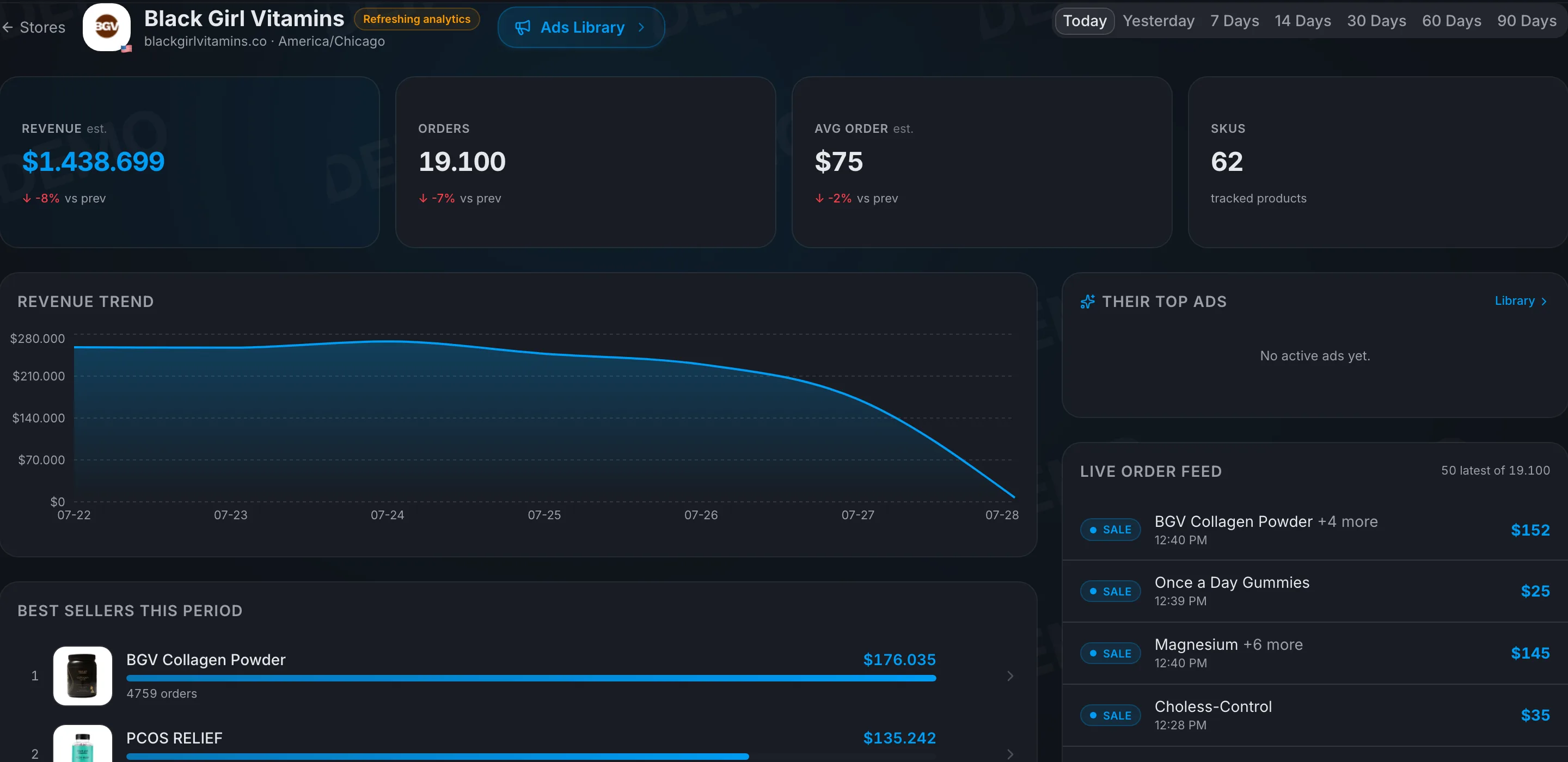
RivlWatch takes a different route: it tracks the Shopify store itself — observed orders, not estimates — and joins that to the Meta ads driving them, with an AI that reads any creative you open. Here is the honest side-by-side, including where TrendTrack is the better pick.
| Capability | RivlWatch | TrendTrack |
|---|---|---|
| Shopify sales data | Observed live orders | None — store metrics are SimilarWeb traffic and Meta ad activity, not orders |
| Ads + sales in one view | Yes | Ads, emails and traffic side by side; no sales side |
| Meta ad gallery per store | 500, up to 8,000 on demand | Per-shop Meta ad history inside Shop Analytics; searchable Ads Library starts at Pro (€89) |
| AI reads a creative on demand | Video + audio | Strategy insights per brand — frequency, formats, key messages |
| Real audience data (EU reach, age×gender) | Meta DSA disclosures | EU reach + spend per ad, daily per tracked brand (Pro up) |
| Ad-dependency score (Repeat Index) | Agency plan | None — no sales signal to score against |
| Daily store history | Yes | Daily, 24h refresh — ads, emails, traffic, product launches |
| Credit system | None | Result-page metering (filter change or next page = 1); ads unlimited from Pro, advertisers 2,000 pages/mo on Pro, mail capped on Starter |
| Ask your AI (MCP) | Yes | Yes — read-only OAuth MCP (Claude, ChatGPT, Perplexity, Gemini) |
| From | $49/mo | €59/mo (€42 annual) |
Checked against each vendor’s own site in July 2026 — always confirm current details with them. TrendTrack tiers: Starter €59, Pro €89 and Business €149 a month as of July 2026, falling to €51 / €76 / €127 on quarterly billing and €42 / €63 / €105 on annual (their toggle labels these −15% and −30%), with 1 / 2 / 4 users included and extra seats at $20 each; an Enterprise tier is custom-priced. Sign-up is free with no card required. The Starter tier carries no Ads Library or Advertisers module — the ad-spy side of the product starts at Pro. Read off trendtrack.io/pricing, which prices in euros.
Where TrendTrack shines
- Freshness at serious scale. The homepage advertises an ad library of 250M+ ads with about two million added every day, a shop library of a million-plus stores, and a hard 24-hour refresh across the product — their FAQ leans into it: most tools show you last month, TrendTrack aims to show you today. For scanning the whole market for what is working right now, that cadence is real.
- It watches more than ads. BrandTracker follows a competitor across ads, emails, traffic and product launches in one dashboard, and the Email Library — automated flows and one-off campaigns, searchable like the ad library — is competitor intelligence RivlWatch has no answer to. A free Chrome extension rides along.
- Honest about where its numbers come from. TrendTrack does not fake a revenue figure: traffic is explicitly SimilarWeb, spend and reach come explicitly from Meta’s EU and UK transparency data, and the daily reach-and-spend trend lines per tracked brand (from Pro) are genuinely useful budget intelligence you cannot get from a storefront.
- Easy to try, easy to script. Sign-up is free with no card required, every plan ships API access with published rate limits (5 to 40 requests a second by tier), and a read-only OAuth MCP connects the dataset to Claude, ChatGPT, Perplexity, Gemini, Manus or n8n in a few clicks.
Where RivlWatch wins
- TrendTrack publishes no sales numbers at all — and is upfront about it: ad spend comes from Meta’s own data and store traffic from SimilarWeb, by their own FAQ. That honesty is to their credit, but it means the store-level question you actually care about — is this brand selling more this week than last — is answered with traffic, which measures attention, not conversion. RivlWatch answers it with orders: it polls each tracked store’s public storefront around the clock and records the sell-through it observes — products whose public records change together in the same second count as one observed order, valued at the product’s lowest listed price — and derives revenue from that. No traffic figure enters the chain.
- The join. TrendTrack’s shop view lines up ads, emails and traffic; RivlWatch lines up a store’s observed daily orders beside that same store’s live Meta ad gallery. When a competitor’s creative starts scaling, you do not check whether visits followed — you check whether orders did, on the same screen.
- Their AI layer summarizes strategy; ours reads the creative. TrendTrack’s Meta Ads strategy insights return a brand-level read — frequency, formats used, key messages, per their own pricing page. RivlWatch’s AI opens the creative you choose and watches the actual video — frames plus audio — then returns the hook, the story arc, the CTA wording and a word-for-word voiceover transcript. Results are cached, so re-opening a creative you have already read costs nothing.
- Both read Meta’s EU transparency disclosures, and TrendTrack does real work with them — reach and spend per ad, daily per-brand trend lines. RivlWatch reads the same disclosures one layer deeper, showing the age × gender delivery split beside EU reach for every ad that ran in the EU. Plan placement differs too: on TrendTrack the whole ad-library side — ad search, advertiser search, EU reach and spend — starts at Pro (€89), while the €59 Starter keeps shop browsing and two BrandTracker slots; on RivlWatch the per-store ad gallery and the DSA audience data come with every plan.
- The Repeat Index scores whether a product keeps selling once its ads stop — a question that needs a sales signal, which TrendTrack does not collect. It is an Agency-plan feature, and on Agency it filters the entire product feed.
When TrendTrack is the better choice
If your work is market-wide, TrendTrack is the better buy: an ad library it puts at 250M+ ads growing by millions a day, shops mapped by SimilarWeb traffic and growth, an email library RivlWatch has no equivalent of, EU reach and spend trend lines per brand from the €89 Pro plan, and a free no-card start that makes trying it costless. Media buyers and creative strategists hunting angles across the whole market will get more from it than from a store-level tracker. RivlWatch earns its keep at the next stage — when specific Shopify competitors matter enough that you want their orders observed rather than their traffic charted.
Coming from TrendTrack: what maps to what
Frequently asked
Is RivlWatch a good TrendTrack alternative?
For Shopify competitor tracking, yes — with a clear split. TrendTrack is a market-wide intelligence layer: shops mapped by SimilarWeb traffic, an ad library refreshed daily, email flows, EU spend trend lines. RivlWatch is a store-level evidence layer: it observes the orders happening on the storefronts you track and joins them to each store’s live Meta ads, with an AI read available on any creative you open. If your bottleneck is finding what is moving across the market, TrendTrack; if it is knowing whether a named competitor actually sells, RivlWatch.
Does TrendTrack show a store’s sales or revenue?
No, and they do not pretend otherwise. TrendTrack’s own FAQ names its two store-level sources — ad spend from Meta’s data, traffic from SimilarWeb — and there is no order or revenue figure anywhere in the product; shop health is read through visits, ad activity and email cadence. RivlWatch sits on the other side of that line: it polls a tracked store’s public storefront, records the orders it observes there, and derives revenue from those orders and the listed price. Neither tool sees the merchant’s ledger; the difference is that one charts attention and the other counts observed sell-through.
What is the difference between TrendTrack’s BrandTracker and RivlWatch’s tracked stores?
BrandTracker is a watchlist refreshed every 24 hours: for each brand you slot in (2 on Starter, 30 on Pro, unlimited on Business) it re-reads ads, emails, traffic and product launches, with automated strategy insights and — from Pro — daily EU reach and spend. A RivlWatch tracked store is polled around the clock for the one thing BrandTracker does not carry: observed orders, kept as daily history with best-sellers and restocks, with the store’s Meta ad gallery and DSA audience data attached. Breadth of signals versus depth on the sales signal.
What does RivlWatch do that TrendTrack doesn’t?
Observed orders instead of traffic — RivlWatch records the sell-through it detects on a store’s public storefront, so the daily number is about buying, not visiting. The ads-to-sales join: that order curve sits beside the same store’s Meta ad gallery. Per-creative AI: TrendTrack’s strategy insights summarize a brand’s approach, while RivlWatch’s AI watches the video you open — frames and audio — and returns the hook, story arc, CTA and a full transcript. The age × gender delivery split beside EU reach, where TrendTrack shows reach and spend. And on the Agency plan, a Repeat Index that scores whether a product keeps selling once its ads stop. One thing that is not an edge: both products publish an MCP, so either can be queried from Claude or ChatGPT.
Can I use TrendTrack and RivlWatch together?
It is a natural stack. TrendTrack is built for the wide pass — spotting rising shops by traffic and growth, mining creative angles from a daily-refreshed ad library, reading competitor email programs. When that pass produces names you intend to act on, put those stores into RivlWatch and let the evidence accumulate: observed orders, the full ad gallery, AI creative reads. Market map first, storefront truth second.
How much does RivlWatch cost compared to TrendTrack?
RivlWatch starts at $49/mo, with $89 and $199 plans above it and a 3-day free trial (card required, nothing charged until it ends). TrendTrack starts around €59/mo. There is no credit system: you never top up to run one more search. Each plan has its own limits — stores tracked, ads kept per store, AI analyses per month — and you can see them all on the pricing page.
See the difference on a real store
Open the live demo — real brands, observed sales, real ads — or audit any competitor free in ~30 seconds.