
RivlWatch vs GetHookd
GetHookd calls itself "Facebook Ads Library On Steroids": an ad-spy and creative-production platform with an ad library its pages put at 21–23 million ads across Facebook, TikTok and Google, Brand Spy competitor tracking, a permanent swipe file that keeps ads after they go offline, AI that writes video scripts, clones image ads and transcribes creatives, and a documented REST API plus a hosted MCP server over the same library.
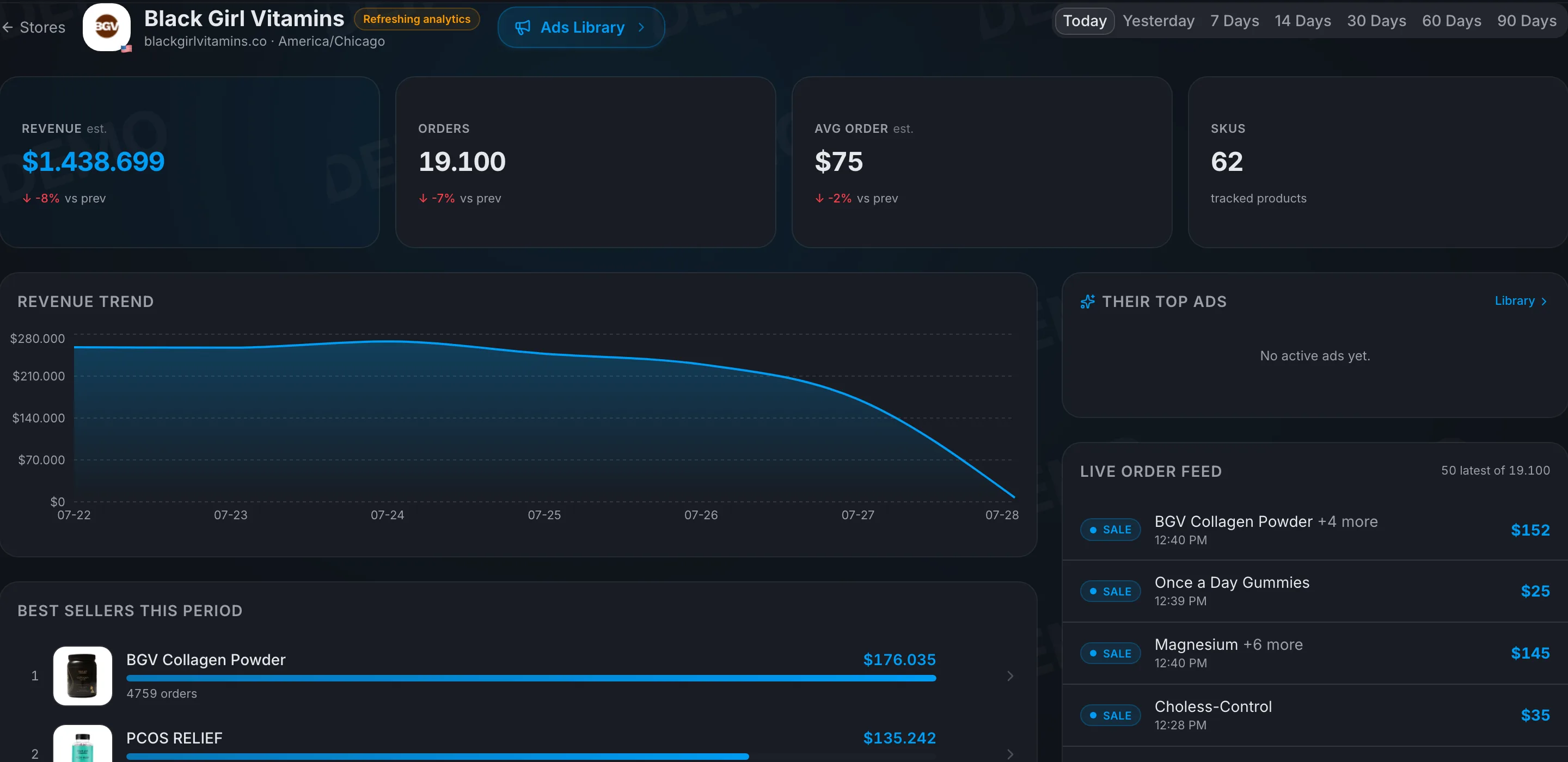
RivlWatch takes a different route: it tracks the Shopify store itself — observed orders, not estimates — and joins that to the Meta ads driving them, with an AI that reads any creative you open. Here is the honest side-by-side, including where GetHookd is the better pick.
| Capability | RivlWatch | GetHookd |
|---|---|---|
| Shopify sales data | Observed live orders | None found on their pages — ad longevity and engagement are the proxy |
| Ads + sales in one view | Yes | No store side to join — ads and landing pages only |
| Meta ad gallery per store | 500, up to 8,000 on demand | Searchable 21M+ library; Brand Spy per brand domain (8 credits) |
| AI reads a creative on demand | Video + audio | Transcription (1 credit) plus AI that writes scripts and clones images |
| Real audience data (EU reach, age×gender) | Meta DSA disclosures | "Audience targeting approaches" and engagement; no EU DSA reach found |
| Ad-dependency score (Repeat Index) | Agency plan | None — no sales data to score against |
| Daily store history | Yes | Ad archive back to 2018; no store sales history |
| Credit system | None | Credits on every plan — Brand Spy 8, scripts and clones 5, transcription 1; no rollover |
| Ask your AI (MCP) | Yes | Yes — hosted MCP, 27 tools over the ad library |
| From | $49/mo | $29/mo ($19 annual) |
Checked against each vendor’s own site in July 2026 — always confirm current details with them. GetHookd tiers: Starter $29, Pro $49, Team $79 and Agency $129 a month as of July 2026, or $19 / $32 / $52 / $83 a month on annual billing (their toggle says save ~35%), carrying 50 / 150 / 400 / 800 monthly credits and 1 / 3 / 5 / 10 seats, with a 7-day free trial. Read off the pricing section of gethookd.ai’s homepage — their /pricing URL returned a 404 when we checked.
Where GetHookd shines
- The production half is something RivlWatch does not attempt at all. Upload a winning ad and their AI writes hooks, angles and scripts; Clone Ads turns one image into dozens of variations with new colors, formats and AI avatars; static ad templates and funnel templates take a campaign from research to launch-ready without a designer. If your bottleneck is making creative rather than judging it, that is their core product.
- Breadth and permanence in the library. Their plan bullets cite over 23 million ads across Facebook, TikTok and Google — RivlWatch’s ad data is Meta only — their FAQ says the archive reaches back to 2018, one search covers every Meta placement from Feed to Audience Network, and anything you save stays accessible even after the advertiser turns it off, without a save cap on any plan per their pages.
- A genuinely serious developer surface, rare in the ad-spy class. A documented REST API and a hosted MCP server exposing 27 tools over ad search, brand spy, boards and the swipe file, one bearer token for both, scoped permissions, and a response envelope that reports credits used per call. Claude, Cursor or your own scripts can query the library directly.
- Built for teams at a low entry price. Every tier includes seats (1 to 10), collections can be shared and annotated with research organized per client, there is a Skool community and a Chrome extension, and Starter is $29 a month — $19 on annual billing — behind a 7-day free trial.
Where RivlWatch wins
- GetHookd stops at the creative, and its own pages say what stands in for performance: AI scoring built on campaign longevity, creative testing patterns and engagement velocity, plus a per-ad data overview of placement, activity duration, format, CTA type, category and landing-page link. Those are proxies — an ad can run for months on a product that barely sells. RivlWatch continues into the store: it reads a Shopify store’s public storefront every day, records the orders it observes as they happen, and derives revenue from those orders and the listed price, so "working" means orders moved, not that an ad stayed live.
- The join is the point. Brand Spy shows a competitor’s ads, landing pages and traffic sources; RivlWatch puts a tracked store’s observed daily order curve and that same store’s Meta ad gallery on one page — 500 ads per store, up to 3,000 via "Load more" — so you can see which creatives were live on the days the orders actually moved.
- Their AI writes and transcribes; ours takes creatives apart. Ads Transcription converts a video to copy for one credit, and Video Scripts generates new hooks from a winner you upload. Open a video creative in RivlWatch and the AI watches the frames and hears the audio, then returns the hook, the story arc, the CTA wording and a full voiceover transcript in the original language — cached, so re-reading a creative you have already analyzed costs nothing.
- Audience evidence rather than audience inference. For ads a competitor ran in the EU, RivlWatch shows Meta’s own DSA disclosure — delivered reach and the age × gender split, published by Meta itself. GetHookd’s pages describe Brand Spy surfacing "audience targeting approaches" and engagement signals; we did not find EU reach or an age × gender breakdown anywhere on the pages we fetched.
- Everything analytical there draws a credit balance: Brand Spy is 8 credits per brand spied, scripts and clones 5, transcription 1, and their FAQ is explicit that unused credits do not roll over — even purchased top-up packs expire with the billing cycle. On Starter’s 50 credits, that is six brands spied in a month. RivlWatch has no per-view currency: once a store is tracked, its sales history and ad gallery stay open to you, and nothing draws down when you look again.
When GetHookd is the better choice
If the work in front of you is making ads, buy GetHookd — RivlWatch generates no creative at all, and their script generator, ad cloning, static templates and funnel pages are a real production line from $29 a month. Buy GetHookd too if you want TikTok and Google ads in the same swipe file, since RivlWatch’s ad data is Meta only, or if a team needs seats, shared boards and an API over a huge ad archive. RivlWatch earns its place when the question changes from "what should our next ad look like" to "is this competitor’s product actually selling, and which creative is carrying it" — answering that needs a store’s observed orders, and an ad library alone cannot supply them.
Coming from GetHookd: what maps to what
Frequently asked
Is RivlWatch a good GetHookd alternative?
For competitor intelligence on Shopify brands, yes — with one honest caveat. GetHookd is half research, half production: if you lean on its script generator, ad cloning and templates, RivlWatch replaces none of that. What RivlWatch replaces is the research half, from a different direction. Instead of inferring what works from how long an ad has run and how it engages, it observes the orders happening on a store’s public storefront and shows them beside that store’s Meta ads, with an AI read available on any video creative you open.
Does GetHookd show how much a store is selling?
We did not find sales or revenue data anywhere on their pages. What GetHookd attaches to an ad is placement, activity duration, format, CTA type, category and the landing-page link, plus AI performance scoring built on campaign longevity, creative testing patterns and engagement velocity — their own guidance treats a long-running ad as the sign of a winner. That is a reasonable proxy, and it is still a proxy. RivlWatch answers the question directly: it polls the storefront itself and reports the orders it observed there, day by day, with revenue derived from those orders and the listed price.
Does GetHookd have an API or MCP server?
Yes, and credit where due — it is one of the few tools in this class that does. A documented REST API and a hosted MCP server with 27 tools spanning ad search, brand spy, boards and the swipe file; one token authenticates both, search calls draw the same credit balance as the app while lookups are free, and access is gated to paid plans via their public_api flag. The difference is what the tools reach. GetHookd’s MCP queries its ad library and your swipe file; RivlWatch’s MCP queries the stores you track — their observed daily sales, best-sellers and Meta creatives — so your AI reasons over evidence about named competitors, not just examples to swipe.
What does RivlWatch do that GetHookd doesn’t?
Orders observed off a store’s public storefront rather than inferred from ad longevity. The ads-to-sales join: a tracked store’s daily order curve and that same store’s Meta ad gallery in one view. Meta’s DSA-disclosed EU reach and age × gender split on ads that ran in the EU. Daily store history — best-sellers, restocks, price moves — where GetHookd’s history is an archive of ads back to 2018. And on the Agency plan, the Repeat Index, which scores whether a product keeps selling once its ads go quiet. In the other direction, GetHookd does plenty RivlWatch doesn’t: it writes scripts, clones creatives, ships templates and funnels, and covers TikTok and Google ads — RivlWatch’s ad data is Meta only.
Can I use RivlWatch and GetHookd together?
The pairing is unusually clean because the products barely overlap. Keep GetHookd as the creative side — the swipe file across Facebook, TikTok and Google, the script generator, the clones and templates that feed your production line. Point RivlWatch at the handful of Shopify competitors you take seriously, where each one gets observed daily orders, its Meta ad gallery beside that curve, AI reads of the creatives you open, and Meta’s EU audience disclosures. One tool helps you make the next ad; the other tells you whether a rival’s ads are attached to a product that actually sells.
How much does RivlWatch cost compared to GetHookd?
RivlWatch starts at $49/mo, with $89 and $199 plans above it and a 3-day free trial (card required, nothing charged until it ends). GetHookd starts around $29/mo. There is no credit system: you never top up to run one more search. Each plan has its own limits — stores tracked, ads kept per store, AI analyses per month — and you can see them all on the pricing page.
See the difference on a real store
Open the live demo — real brands, observed sales, real ads — or audit any competitor free in ~30 seconds.