
RivlWatch vs Arcads
Arcads is an AI ad-generation studio — a different job from RivlWatch. It puts 1,000+ AI actors and the major video models (Sora 2, Veo 3.1, Kling 3.0, Seedance 2.0) behind one credit-metered subscription: actors deliver your script to camera with lip-sync and emotion control, B-roll models render product shots, videos translate into more than 30 languages, and workflow canvases batch one ad into dozens of variations. It generates ads; it does not track stores or sales.
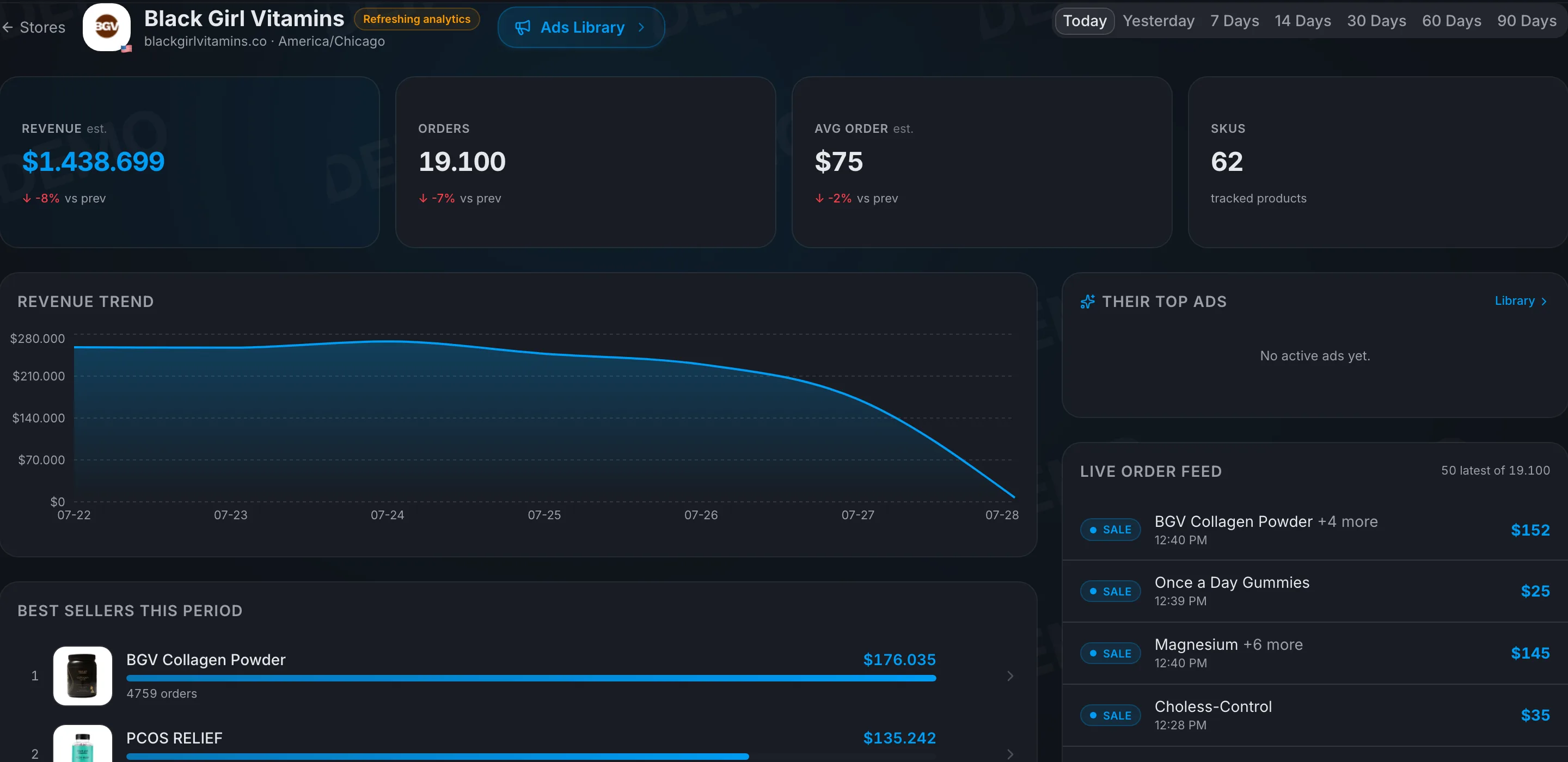
RivlWatch takes a different route: it tracks the Shopify store itself — observed orders, not estimates — and joins that to the Meta ads driving them, with an AI that reads any creative you open. Here is the honest side-by-side, including where Arcads is the better pick.
| Capability | RivlWatch | Arcads |
|---|---|---|
| Shopify sales data | Observed live orders | None — Arcads generates ads, it does not watch stores |
| Ads + sales in one view | Yes | No — a creation studio, not a research tool |
| Meta ad gallery per store | 500, up to 8,000 on demand | No ad library in the product; a /spy-competitor-ads command ships in their MCP skills plugin |
| AI reads a creative on demand | Video + audio | Generation, not analysis — AI actors deliver your script to camera |
| Real audience data (EU reach, age×gender) | Meta DSA disclosures | None — no reach or audience data |
| Ad-dependency score (Repeat Index) | Agency plan | None — no sales signal to score |
| Daily store history | Yes | None — projects and renders, not store history |
| Credit system | None | Yes — every generation is credit-metered; Starter and Creator pause at their monthly cap |
| Ask your AI (MCP) | Yes | Yes — hosted MCP that generates ads from Claude Desktop |
| From | $49/mo | $110/mo reported — no public pricing page |
Checked against each vendor’s own site in July 2026 — always confirm current details with them. Arcads tiers: Arcads publishes no pricing page — arcads.ai/pricing returned a 404 when we checked in July 2026, and prices appear only at the in-app paywall after signup. As of July 2026 their help center documents Starter (8,000 credits a month) and Creator (16,000 credits a month), both of which pause the account when credits run out, with PRO, Scale and Business tiers above by contact — PRO bills overage per extra credit, and larger volumes get a lower per-credit rate. Reviews that captured the paywall in June 2026 consistently report Starter at $110/mo and Creator at $220/mo. Their credit table prices a talking-actor video at 800 credits per minute per actor, B-roll generations at roughly 24–1,620 credits depending on model and resolution, and images free up to 100 a day.
Where Arcads shines
- The best-known name in AI UGC generation, and the actor stack is genuinely deep: a library of 1,000+ AI actors, a custom actor from a single headshot, a clone of yourself with your own voice, emotion written straight into the script, gesture presets, and OmniHuman 1.5 for full-body realism rather than just moving lips.
- A real model aggregator. One subscription fronts Sora 2 and Sora 2 Pro, Veo 3.1, Kling 3.0 up to 4K, Seedance 2.0 and Grok for video, plus GPT Image 2, Nano-Banana 2 and Seedream for images — with 100 images a day free of credits — so you pick the model per shot instead of buying five tools.
- Built for volume testing, which is how performance ads are actually made: infinite-canvas Workflows turn one winning ad into 20 UGC variations across actors and languages in a single run, presets cover unboxing POV, product showcase and show-your-app, and any video translates with matched lip-sync in more than 30 languages.
- They take AI clients seriously: a hosted MCP server at mcp.arcads.ai generates video ads straight from Claude Desktop, and an official skills plugin adds commands like /spy-competitor-ads, /clone-hook and /clone-static-ad.
Where RivlWatch wins
- The two tools do different jobs, so the honest edge is sequence, not superiority. Arcads starts at the script box and assumes you already know what the ad should say. RivlWatch starts one step earlier: it watches the Shopify stores you pick, records the orders it observes on their public storefronts, and puts each store’s live Meta ads beside its sales curve — so the brief you carry into a generation tool is grounded in what is selling right now, not in what looks good.
- Any competitor creative you open can be read by AI — the model watches the frames and hears the audio, then returns the hook, story arc, CTA wording and a word-for-word voiceover transcript in the original language. That output is exactly the shape a tool like Arcads consumes: a proven hook for its Hook Repurposer, a script skeleton for a talking actor, an angle for the next batch of variations.
- A generation tool cannot tell you what delivered; Meta can. RivlWatch surfaces Meta’s DSA disclosures — real EU reach and the age × gender delivery split — on any of a competitor’s ads that ran in the EU, so before you multiply a “winner” into twenty versions, you can check whether the original actually reached anyone. Ad data in RivlWatch is Meta only, and DSA figures exist only for ads that delivered in the EU.
- The MCPs compose instead of competing. Arcads’ hosted MCP generates ads from a Claude chat; RivlWatch’s MCP feeds the same chat the competitor evidence — tracked stores, observed sales, ad galleries, creative reads. Their own skills plugin shipping a /spy-competitor-ads command says it plainly: generation starts with knowing what competitors run. RivlWatch is that layer, with observed sales attached.
When Arcads is the better choice
If you want AI-generated video ads, buy Arcads — RivlWatch does not generate ads at all, and nothing on this page substitutes for 1,000+ actors, the major video models under one subscription and workflows that batch a winning ad into twenty variations. The two are not rivals; they are consecutive steps. Arcads is the better buy the moment your problem is production. RivlWatch earns its place earlier, while the question is still which ads deserve to be produced: what your competitors run, what actually sells while it runs, and what the winning creatives say. If you can only fund one and you already know what to make, fund Arcads.
Using Arcads? What RivlWatch adds in front of it
Frequently asked
Is RivlWatch an alternative to Arcads?
No, and this page will not pretend otherwise. Arcads generates video ads: AI actors deliver your script to camera, video models render B-roll, workflows batch the variations. RivlWatch does not generate ads at all — it watches the Shopify stores you choose, records the orders it observes on their public storefronts, shows the live Meta ads running above them, and reads the creatives you open with AI. If you searched for Arcads because you want to produce ads, Arcads is the right category. RivlWatch is the research layer that tells you what to produce.
How much does Arcads cost?
Arcads publishes no pricing page — arcads.ai/pricing returned a 404 when we checked in July 2026, and prices appear only after signup, at the in-app paywall. Their help center describes a Starter plan with 8,000 monthly credits and a Creator plan with 16,000, both of which pause the account when credits run out, with PRO, Scale and Business tiers above by contacting the team; PRO bills overage per extra credit. Reviewers who captured the paywall in June 2026 consistently report Starter at $110/mo and Creator at $220/mo. Their credit table prices a talking-actor video at 800 credits per minute per actor — so Starter buys roughly ten minutes of finished talking-actor video a month — with B-roll generations running 24 to 1,620 credits depending on model and resolution. The refund policy is fair by category standards: a billing period with zero credits used is refunded in full, and there is a one-time 24-hour change-of-mind refund.
Does Arcads tell you which ads are working?
Not inside the product. Their own complete platform guide is generation, editing and automation end to end — actors, video models, presets, workflows — with no ad library, no store tracking and no audience data. The one research surface they ship is the /spy-competitor-ads command in their official MCP skills plugin, which analyses competitor video ads for inspiration. That gap is what RivlWatch fills: observed orders beside a store’s live Meta ads, Meta’s EU reach and age × gender disclosures on the ads that delivered in the EU, and an AI read of any creative you open.
Can I use Arcads and RivlWatch together?
That is the natural setup, and the honest way to read this page. Research first: watch the competitors that matter, see which of their products keep selling in observed orders, note which of their Meta creatives carry real EU reach, and let the AI read hand you the winning ad’s hook, story arc, CTA wording and word-for-word transcript. Then produce: take that brief into Arcads, put it on an actor that fits the audience, and let a workflow batch the variations. Both products expose an MCP server, so a single Claude conversation can pull competitor evidence from RivlWatch and generate the ads with Arcads without leaving the chat.
Does RivlWatch generate ads like Arcads?
No. RivlWatch has no actors, no video models and no rendering — nothing it makes goes into your ad account. What it produces is the input a generation tool wants: which competitor products are selling right now in observed orders, which Meta creatives have been running against them, what those creatives say — hook, story arc, CTA and full transcript, from an AI read of the frames and audio of a creative you open — and what Meta’s DSA disclosures show actually delivered in the EU. If your bottleneck is producing ads, buy Arcads. If your bottleneck is knowing what the winning ads in your niche look like before you spend credits generating, that is RivlWatch.
How much does RivlWatch cost compared to Arcads?
RivlWatch starts at $49/mo, with $89 and $199 plans above it and a 3-day free trial (card required, nothing charged until it ends). Arcads starts around $110/mo, reported from their in-app paywall. There is no credit system: you never top up to run one more search. Each plan has its own limits — stores tracked, ads kept per store, AI analyses per month — and you can see them all on the pricing page.
See the difference on a real store
Open the live demo — real brands, observed sales, real ads — or audit any competitor free in ~30 seconds.