
RivlWatch vs Atria
Atria is an AI creative-intelligence platform for Meta and TikTok marketing teams: an ad inspiration library it says holds 100M+ ads with AI search and multi-level boards, brand following with weekly updates, performance analytics on your own connected ad accounts with automatic creative tagging, AI generation of briefs, scripts, copy and image ads, and an agent called Raya that ties the workflow together.
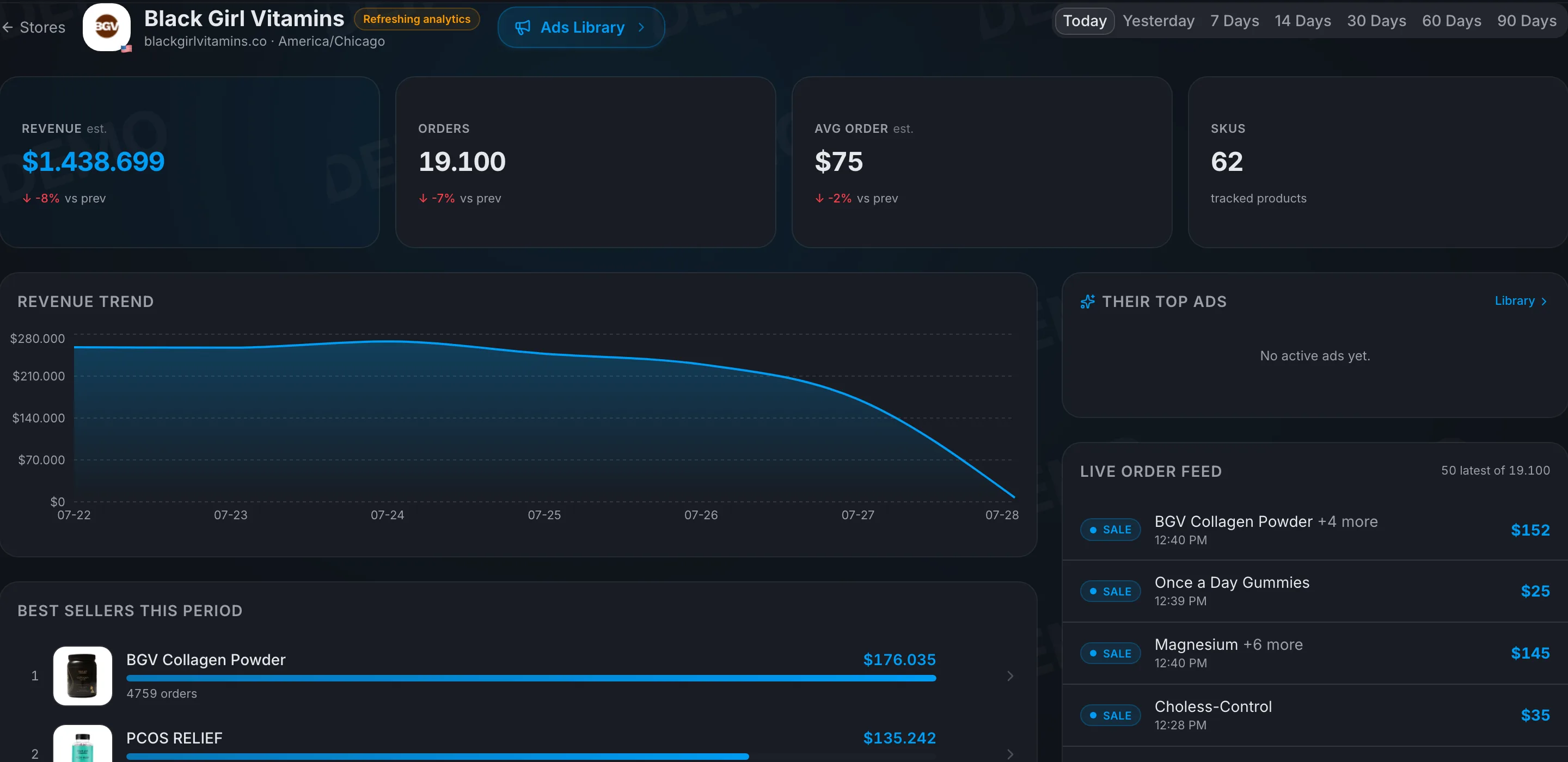
RivlWatch takes a different route: it tracks the Shopify store itself — observed orders, not estimates — and joins that to the Meta ads driving them, with an AI that reads any creative you open. Here is the honest side-by-side, including where Atria is the better pick.
| Capability | RivlWatch | Atria |
|---|---|---|
| Shopify sales data | Observed live orders | None — no store sales data published |
| Ads + sales in one view | Yes | Own connected ad accounts only; competitors are creative-only |
| Meta ad gallery per store | 500, up to 8,000 on demand | Inspiration library (claims 100M+ Meta + TikTok ads); follow 50–200 brands by plan |
| AI reads a creative on demand | Video + audio | Yes — auto-tags, grading, briefs, generation (draws AI credits) |
| Real audience data (EU reach, age×gender) | Meta DSA disclosures | None shown on its published library pages as of July 2026 |
| Ad-dependency score (Repeat Index) | Agency plan | None (no sales layer) |
| Daily store history | Yes | Ad run dates and weekly brand updates; no sales history |
| Credit system | None | AI credits, 4,000–25,000/mo by plan |
| Ask your AI (MCP) | Yes | Yes — REST API and MCP endpoint |
| From | $49/mo | $159/mo ($129 annual); free plan |
Checked against each vendor’s own site in July 2026 — always confirm current details with them. Atria tiers: Core $159, Plus $599 and Business $1,199 a month as of July 2026, or $129 / $479 / $959 a month billed annually (20% off), plus a custom-priced Enterprise tier; a free plan exists and needs no card. Plans are team-shaped: 5 / 8 / 15 seats included ($20 per extra seat a month), 4,000 / 10,000 / 25,000 monthly AI credits, 5 / 10 / unlimited connected ad accounts and a $500K / $1M / unlimited cap on monthly ad spend analyzed. Read off tryatria.com/pricing — the page defaults to annual figures and the monthly ones sit behind the Pay-monthly toggle.
Where Atria shines
- A genuinely large, well-curated inspiration layer. Their pricing FAQ claims an ad library of “100M+ ads from Meta and TikTok, updated weekly” (the API page says 25M+ are searchable), with AI-powered search, filters by theme, format, industry and language, sorting by longest-running, and saving via a Chrome extension or from mobile Instagram into multi-level boards. They will even migrate your saved boards from Foreplay or MagicBrief free of charge.
- A closed loop on your own advertising that no spy tool offers. Atria connects to your Meta and TikTok ad accounts, auto-tags creatives by hook, persona, USP and format, grades ads in plain English with fix recommendations, builds custom and comparison reports, and bulk-uploads approved ads back to Meta in a few clicks. Teams like Kitsch, Ipsy and Blenders Eyewear run cross-functional teams on it, and the platform is SOC 2 Type II certified.
- Real creative production, not just research: AI-generated image ads informed by performance data, ad concepts, hooks, scripts and copy, variants of winning video scripts, customer-review mining for angles, URL-to-brief analysis, and asset storage from 5 GB to 5 TB searchable by visual element, voice-over or on-screen text.
- A published developer surface: a REST API plus an MCP endpoint (api.tryatria.com/mcp) that plugs into Claude, ChatGPT or Cursor — rare in this category, and a sign the product is built to sit inside a team’s tooling rather than only in a browser tab.
Where RivlWatch wins
- Atria has no sales dimension. Nothing on its homepage, pricing page, API docs or public ad galleries claims store sales or revenue data — the platform is creatives plus your own ad-account metrics. RivlWatch is built around the missing half: it reads a store’s public storefront every day, records the orders it observes, derives revenue from those orders and the listed price, and puts that curve next to the store’s Meta ads. When you find a competitor’s creative in a library, the question Atria cannot answer is whether the store behind it is actually selling.
- Competitor performance context without connecting anything. Atria’s performance analytics run on accounts you own; on competitors you get creatives, run dates and landing pages. RivlWatch shows Meta’s DSA disclosures on the competitor’s own ads — EU reach and the age × gender delivery split, which Meta publishes for ads that ran in the EU — beside the observed order history of the store running them.
- Store-first depth instead of library breadth. RivlWatch pulls 500 ads per tracked store into the gallery, up to 3,000 via Load more, and keeps daily order history, best-sellers and restocks on every store you track; Atria’s brand-following is capped at 50 to 200 brands by plan and stays creative-only. The trade runs the other way too: Atria’s library spans Meta and TikTok, while RivlWatch’s ad data is Meta only.
- Priced for a solo operator, not a seat count. Atria’s ladder is team-shaped — seats, AI credits and an ad-spend-analyzed cap — and its AI features draw on a 4,000-to-25,000 monthly credit balance. RivlWatch starts at $49/mo with no credit currency: the AI read of a creative you open is cached, re-opening it costs nothing, and plans set capacity rather than a balance you spend by looking.
When Atria is the better choice
If your team produces ads and runs its own Meta and TikTok accounts, buy Atria — brief generation, auto-tagging, plain-English grading, bulk upload and a real asset pipeline are things RivlWatch does not attempt, and the free plan means trying it costs nothing. Atria is a creative operations platform with an inspiration library attached. RivlWatch answers a different question: what a specific Shopify competitor is actually doing — observed orders, day by day, next to the Meta ads driving them. If your bottleneck is making creative, choose Atria; if it is knowing whether a rival’s creative is selling, that is what RivlWatch watches.
Coming from Atria: what maps to what
Frequently asked
Is RivlWatch a good Atria alternative?
Only for one slice of what Atria does. Atria is a creative operations platform — inspiration library, brand following, AI production, and analytics plus bulk upload on your own Meta and TikTok accounts. RivlWatch is competitor observation — the Shopify stores you choose, their observed daily orders, and each store’s Meta ad gallery with an AI read available on any creative you open. If what pulled you to Atria was competitor intel rather than creative production, RivlWatch goes deeper on that slice; if you need briefs, generation and reporting, it does not replace Atria.
Does Atria show a competitor’s sales?
No. Across Atria’s published pages — homepage, pricing, API docs and its public ad galleries — there is no claim of store sales or revenue data; the competitor side is creatives, run dates and landing pages, and the performance side runs on ad accounts you connect yourself. RivlWatch’s core is exactly that missing signal: it polls a store’s public storefront daily, records the orders it observes, and shows the sales curve beside the store’s Meta ads.
What does Atria do that RivlWatch doesn’t?
A lot — the tools barely overlap. Atria generates creatives (image ads, hooks, scripts, copy, briefs from a URL), auto-tags and grades the ads in your own Meta and TikTok accounts, builds reports, bulk-uploads to Meta, stores terabytes of assets, and its inspiration library covers TikTok as well as Meta. RivlWatch produces no creatives, connects to no ad accounts, and its ad data is Meta only. What it does instead is watch specific Shopify stores: observed daily orders, best-sellers, restocks, and the store’s Meta ad gallery with DSA reach and age × gender data on the ads that ran in the EU.
What does RivlWatch do that Atria doesn’t?
The sales join. RivlWatch observes a store’s orders off its public storefront and puts the daily curve next to that store’s Meta ads, so you can see whether the creative you admire has a selling store behind it. Per competitor ad it shows Meta’s DSA disclosures — EU reach and the age × gender delivery split. Any video creative you open can be read by AI: frames watched, audio heard, and the hook, story arc, CTA wording and a full transcript handed back. And on the Agency plan, a Repeat Index that scores whether a product keeps selling once its ads stop. Both products publish an MCP endpoint, so that part is a tie.
Can I use RivlWatch and Atria together?
They stack naturally, because they cover different halves of the job. Atria is the studio: inspiration, briefs, generation, and analytics on the accounts you run. RivlWatch is the watchtower: the competitor stores you track, their observed orders and their Meta creatives. Both expose MCP endpoints, so Claude or ChatGPT can sit across the two — pull a rival’s observed sales spike from RivlWatch, then brief a response in Atria.
How much does RivlWatch cost compared to Atria?
RivlWatch starts at $49/mo, with $89 and $199 plans above it and a 3-day free trial (card required, nothing charged until it ends). Atria starts around $129/mo on annual billing ($159 monthly). There is no credit system: you never top up to run one more search. Each plan has its own limits — stores tracked, ads kept per store, AI analyses per month — and you can see them all on the pricing page.
See the difference on a real store
Open the live demo — real brands, observed sales, real ads — or audit any competitor free in ~30 seconds.