
RivlWatch vs Minea
Minea is a French ad-spy and product-research platform built around the Meta ads library, with separate TikTok and Pinterest ad libraries, influencer product-placement tracking, daily niche lists and Shopify store revenue estimates, sold on three monthly plans.
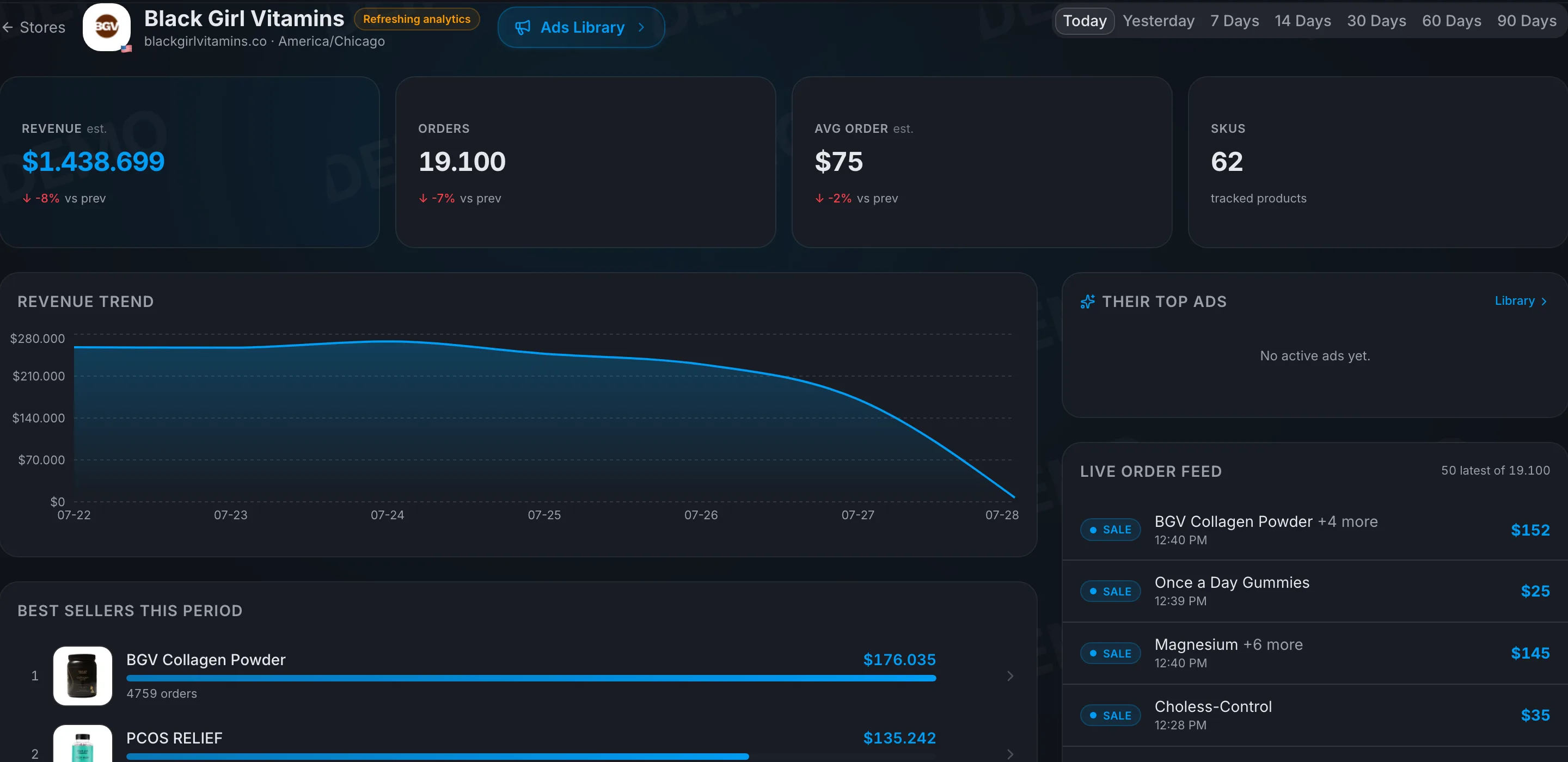
RivlWatch takes a different route: it tracks the Shopify store itself — observed orders, not estimates — and joins that to the Meta ads driving them, with an AI that reads any creative you open. Here is the honest side-by-side, including where Minea is the better pick.
| Capability | RivlWatch | Minea |
|---|---|---|
| Shopify sales data | Observed live orders | Estimated — Shop Spy, ±20-30% per their own guide |
| Ads + sales in one view | Yes | Partial — ads and estimated shop revenue |
| Meta ad gallery per store | 500, up to 8,000 on demand | Meta ad library, plus separate TikTok and Pinterest ad libraries |
| AI reads a creative on demand | Video + audio | AI ad analysis + transcript, 10/mo each on Starter |
| Real audience data (EU reach, age×gender) | Meta DSA disclosures | No EU DSA reach data published |
| Ad-dependency score (Repeat Index) | Agency plan | Success Radar trend scoring; no ad-dependency score published |
| Daily store history | Yes | Yes — estimated revenue history, deeper on higher plans |
| Credit system | None | No credits — per-feature monthly caps |
| Ask your AI (MCP) | Yes | None published |
| From | $49/mo | $49/mo (€49/mo) |
Checked against each vendor’s own site in July 2026 — always confirm current details with them. Minea tiers: Starter $49, Premium $99, Business $199 per month, or $39 / $79 / $158 billed quarterly (an annual option sits in the same toggle); the euro ladder is identical (€49 / €99 / €199). No credit system — three features carry monthly caps instead: AI ad analyses and AI transcripts (10 / 50 / Unlimited) and Magic search (50 / 100 / Unlimited).
Where Minea shines
- Broad on Meta and genuinely multi-network: Minea advertises 80M+ active ads and 120k+ daily ad and shop updates, and runs TikTok and Pinterest ad libraries alongside Meta. RivlWatch is deliberately Meta-only.
- Influencer product-placement tracking is a real module RivlWatch has no answer to — Minea indexes placements from tens of thousands of influencers alongside the ad library.
- Good tooling for cold-start research on every plan: daily niche lists, a brand tracker with notifications, AI-powered Magic search, and a free .Store domain included.
Where RivlWatch wins
- Minea’s own published Shop Spy guide describes store revenue as an estimate modelled from traffic data, conversion signals and historical order patterns, with roughly a ±20-30% margin of error. RivlWatch does not model revenue: it polls the storefront around the clock, records the products whose public timestamps move together in the same second as one observed order, and derives revenue from those orders at each product’s lowest listed price.
- Minea meters specific features with monthly caps — its pricing page lists 10 AI ad analyses, 10 AI transcripts and 50 Magic searches a month on Starter. RivlWatch has no credit system at any tier: searching, scrolling a store’s sales history and opening a store’s Meta ad gallery are never charged per lookup. Plan limits, not credits.
- RivlWatch puts a store’s Meta creatives next to that same store’s observed daily orders in one view, so you can see which creatives were live on the days the orders moved. On ads that ran in the EU it also shows Meta’s own disclosed delivery data — total reach and an age×gender breakdown — read straight off Meta’s DSA disclosures rather than reconstructed from public engagement.
- RivlWatch scores whether a product keeps selling once its ads go quiet — a Repeat Index, which is the one thing an ad library cannot tell you; it is an Agency-plan feature. An MCP server also lets Claude, ChatGPT and other MCP clients query your tracked stores, their ads and their sales directly.
When Minea is the better choice
Pick Minea if your research starts from browsing rather than tracking: a very large ad archive to hunt through, influencer product placements (RivlWatch has nothing equivalent), daily niche lists, and the TikTok and Pinterest ad libraries it runs alongside Meta. RivlWatch is Meta-first and Shopify-first and works on a list of stores you choose, so if you do not yet know whose stores to watch, Minea is the better first tool.
Coming from Minea
Frequently asked
Is RivlWatch a good Minea alternative?
If you sell on Shopify and your competitors advertise on Meta, yes. RivlWatch counts the orders it observes on a store’s storefront and puts that daily curve next to the exact Meta creatives running at the time, while Minea’s Shop Spy gives you a modelled estimate (its own published Shop Spy guide cites a ±20-30% margin of error). If you want influencer product-placement data, daily niche lists, or a very large ad archive across Meta, TikTok and Pinterest to browse for cold-start ideas, Minea is genuinely better at that job — plenty of sellers run both.
How much does Minea cost in 2026?
As of July 2026, Minea’s public pricing page lists three plans: Starter $49/mo, Premium $99/mo and Business $199/mo, falling to $39, $79 and $158 on quarterly billing, with an annual option in the same toggle. The euro ladder is identical — €49, €99, €199. Rather than credits, each plan caps three metered features per month: AI ad analyses (10 / 50 / Unlimited), AI transcripts (10 / 50 / Unlimited) and Magic search (50 / 100 / Unlimited). RivlWatch starts at $49/mo and has no credit system.
Are Minea’s sales numbers accurate?
Minea is unusually upfront about this. Its published Shop Spy guide says revenue is estimated from traffic data, conversion signals and historical order patterns, gives roughly a ±20-30% margin of error, and advises using the figures to filter for active stores rather than as financial projections. That is more transparency than most estimate-based trackers offer. RivlWatch takes the other route: it polls the storefront and detects orders as they happen, grouping products whose public update timestamps move together in the same second into one observed order. So the daily figure is a count of orders observed, not a model and not a unit count, and the revenue line is derived from those orders at each product’s lowest listed price — discounts and bundles will move it.
Does Minea meter usage, and does RivlWatch?
Minea caps specific features per month rather than metering everything — its pricing page lists 10 AI ad analyses, 10 AI transcripts and 50 Magic searches a month on Starter, rising to 50 / 50 / 100 on Premium and unlimited on Business. RivlWatch has no credit system: searching, browsing a store’s daily sales history and opening a store’s Meta ad gallery are never charged per lookup. What it has instead is plan limits, listed in full on the pricing page.
How much does RivlWatch cost compared to Minea?
RivlWatch starts at $49/mo, with $89 and $199 plans above it and a 3-day free trial (card required, nothing charged until it ends). Minea starts around $49/mo. There is no credit system: you never top up to run one more search. Each plan has its own limits — stores tracked, ads kept per store, AI analyses per month — and you can see them all on the pricing page.
See the difference on a real store
Open the live demo — real brands, observed sales, real ads — or audit any competitor free in ~30 seconds.