
RivlWatch vs Shophunter
Shophunter is a Shopify spy and product-research tool that estimates a store’s daily revenue from public signals, then pairs that estimate with product discovery and, on its Professional tier, a Facebook ad search.
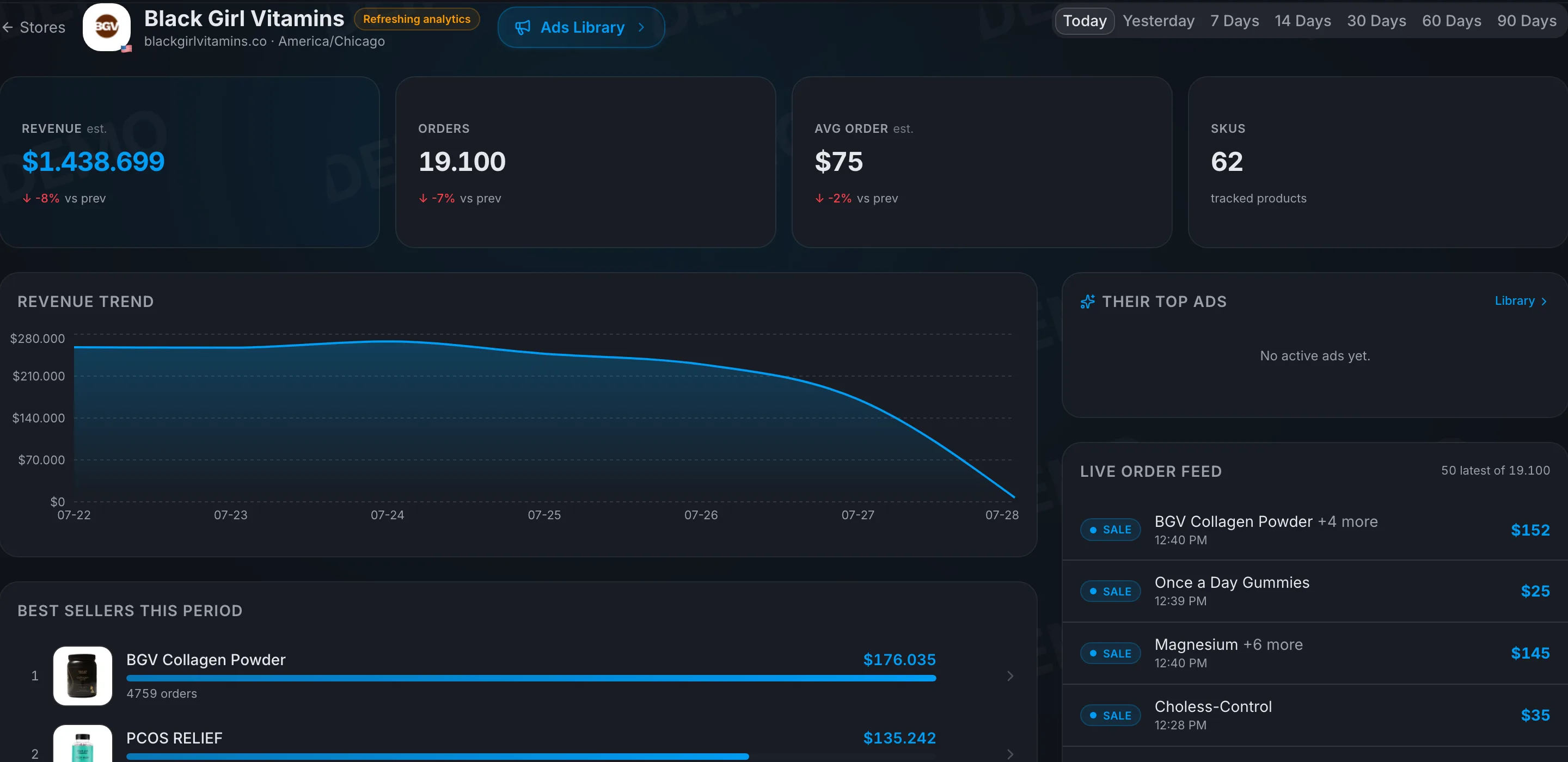
RivlWatch takes a different route: it tracks the Shopify store itself — observed orders, not estimates — and joins that to the Meta ads driving them, with an AI that reads any creative you open. Here is the honest side-by-side, including where Shophunter is the better pick.
| Capability | RivlWatch | Shophunter |
|---|---|---|
| Shopify sales data | Observed live orders | Estimated from public signals |
| Ads + sales in one view | Yes | Ads + revenue estimates, Pro tier |
| Meta ad gallery per store | 500, up to 8,000 on demand | Adspy search, Pro tier |
| AI reads a creative on demand | Video + audio | Not published |
| Real audience data (EU reach, age×gender) | Meta DSA disclosures | Not published |
| Ad-dependency score (Repeat Index) | Agency plan | Sales-concentration signal |
| Daily store history | Yes | Yes, hourly updates |
| Credit system | None | No credits; unlimited stores |
| Ask your AI (MCP) | Yes | Not published |
| From | $49/mo | $50/mo |
Checked against each vendor’s own site in July 2026 — always confirm current details with them. Shophunter tiers: Basic $50/mo or $500/yr, Professional $75/mo or $750/yr, which adds the Adspy search; both list unlimited tracked stores, and a 3-day Basic trial costs $1 and converts to $50/mo. Prices read from their in-app pricing screen, which sits behind their login.
Where Shophunter shines
- Their pricing screen lists unlimited tracked stores on both plans, including the $50 entry tier — no store cap to work around while you triage.
- Paste any Shopify URL and get a daily revenue figure back in seconds, which makes sorting a long list of stores fast.
- Product research built on the filters researchers actually use — their site lists sales velocity, store size, price point and product age — plus hourly updates on tracked stores and historical trends for spotting seasonality.
Where RivlWatch wins
- Shophunter’s own site says it uses traffic patterns, ad counts and conversion behaviour to estimate what a store makes daily. RivlWatch reads the store’s public storefront on a schedule and counts orders as they appear, so the daily curve is observed rather than inferred; revenue is then derived from those observed orders at list price.
- RivlWatch puts a store’s Meta creatives next to that same store’s observed order curve, so you can see which ad the sales moved with. Shophunter pairs its ad search with revenue metrics too, but the revenue shown beside each ad is its own estimate, and the search sits on the $75 Professional tier.
- Open a competitor’s video ad in RivlWatch and the AI reads it, frames and audio, then hands back the hook, angle and CTA — alongside Meta’s own EU reach and age×gender delivery per ad from the DSA disclosures. Shophunter publishes neither on its site.
- The Repeat Index scores whether a product keeps selling after its ads stop — a question you can only answer from an order count over time, never from a revenue estimate. It is on the Agency plan.
When Shophunter is the better choice
If your week is spent triaging hundreds of Shopify stores and a ballpark revenue figure is enough to decide what to test next, Shophunter is the better buy: their plan screen lists unlimited tracked stores from $50/mo, there is a $1 three-day trial, and you get an instant number for any URL you paste. RivlWatch tracks far fewer stores per plan because it polls every one of them for observed orders, so if breadth matters to you more than how the number was produced, RivlWatch is the wrong tool.
Coming from Shophunter
Frequently asked
Is Shophunter’s revenue data accurate?
Shophunter is upfront that the figures are modelled: its site says it uses traffic patterns, ad counts and conversion behaviour to estimate how much a store is making daily. A model like that will land close on some stores and drift on others — that is the nature of estimating from public signals, and it is true of every estimate-based tracker. RivlWatch works from the other end. It reads the store’s own public storefront on a schedule and counts orders as they appear, so the daily order curve is observed rather than inferred. Revenue is then derived from those observed orders at list price, and the product labels it that way.
What is the best Shophunter alternative for observed Shopify sales data?
RivlWatch is the alternative built around observed orders instead of modelled revenue. It polls each tracked store’s public storefront on a schedule, keeps the daily history, and joins that curve to the store’s live Meta ads, with an AI read of the video creatives you open and Meta’s real EU reach and age×gender data per ad. There is also an MCP endpoint, so your own AI assistant can query the same data.
How much does Shophunter cost?
As listed on their in-app pricing screen, which sits behind their login, in July 2026: Basic is $50/mo or $500/year, and Professional — the tier their site markets as Shophunter Pro — is $75/mo or $750/year and adds the Adspy search. Both tiers list unlimited tracked stores, and new accounts can start a 3-day Basic trial for $1 that converts to Basic at $50/mo unless you cancel. Check with them before buying, because SaaS pricing moves.
Does Shophunter show competitors’ Facebook ads?
Yes — the Adspy search, on the $75 Professional tier, with their own shop-revenue metrics shown beside the results. RivlWatch comes at it from the store side: every tracked store carries its own Meta ad gallery with no credits to buy, an AI that reads the video creatives you open for hook, angle and CTA, and Meta’s DSA reach and age×gender breakdown so you can see where the impressions actually landed.
How much does RivlWatch cost compared to Shophunter?
RivlWatch starts at $49/mo, with $89 and $199 plans above it and a 3-day free trial (card required, nothing charged until it ends). Shophunter starts around $50/mo. There is no credit system: you never top up to run one more search. Each plan has its own limits — stores tracked, ads kept per store, AI analyses per month — and you can see them all on the pricing page.
See the difference on a real store
Open the live demo — real brands, observed sales, real ads — or audit any competitor free in ~30 seconds.