
RivlWatch vs PPSPY
PPSPY is a Shopify spy suite for dropshippers — AI-estimated sales tracking, a Meta ad tracker, and large store, product and theme databases, with a Chrome extension for looking at a store while you browse it.
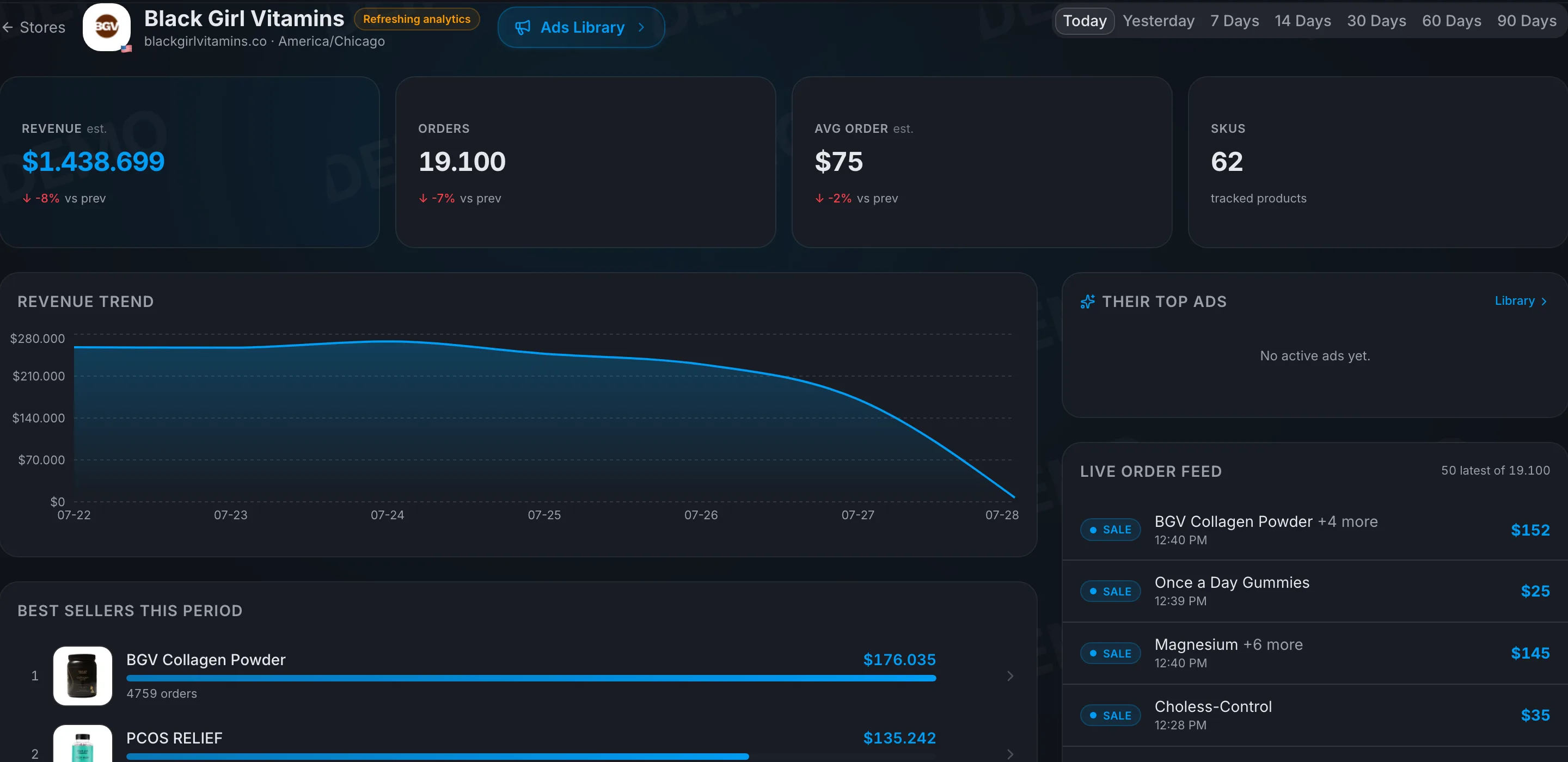
RivlWatch takes a different route: it tracks the Shopify store itself — observed orders, not estimates — and joins that to the Meta ads driving them, with an AI that reads any creative you open. Here is the honest side-by-side, including where PPSPY is the better pick.
| Capability | RivlWatch | PPSPY |
|---|---|---|
| Shopify sales data | Observed live orders | AI-estimated (80.5% accuracy claimed) |
| Ads + sales in one view | Yes | Separate Ad Tracker and Sales Tracker |
| Meta ad gallery per store | 500, up to 8,000 on demand | Yes — Ad Tracker, unlimited downloads |
| AI reads a creative on demand | Video + audio | Creative Hook Analysis (hooks, copy, format) |
| Real audience data (EU reach, age×gender) | Meta DSA disclosures | Not listed on their Ad Tracker page |
| Ad-dependency score (Repeat Index) | Agency plan | Not in their published features |
| Daily store history | Yes | 15-day report per track |
| Credit system | None | Credits: 10K–500K/mo by plan |
| Ask your AI (MCP) | Yes | Separate paid API (from $200) |
| From | $49/mo | $39/mo |
Checked against each vendor’s own site in July 2026 — always confirm current details with them. PPSPY tiers: Standard $39/mo (30 sales-and-ads tracker slots, 10,000 credits/mo), Pro $99/mo (100 slots, 100,000 credits), Business $299/mo (300 slots, 500,000 credits); annual billing at −30% ($328 / $832 / $2,512). Free trial by email signup, no card. Their pricing FAQ states: “you can test PPSPY for free and cancel your subscription at any time. We do not issue refunds.”
Where PPSPY shines
- Genuine breadth: PPSPY publishes coverage of 1M+ Shopify stores and 200M+ products, so discovery searches rarely come back empty.
- A lot of ground under one login — store analysis, product research, app and theme detection, traffic research, and a Chrome extension for in-page lookups.
- A real Meta Ad Tracker: monitor an advertiser, a competitor’s store URL or a landing page, get real-time or daily email alerts on new ads, and batch-download the creatives — their own page says “There are no limits!”
- Aggressive entry economics — $39/mo Standard already includes 30 sales-and-ads tracker slots and 10,000 credits, and a separately priced data API (from $200) exists for teams that want to automate.
Where RivlWatch wins
- PPSPY is upfront that its sales are modelled: its own site says the algorithm “predicts order data”, and its Sales Tracker page promises “reliable estimated sales” with “over 80.5% accuracy”. RivlWatch doesn’t model a store’s volume — it polls each tracked store’s public storefront and records the individual order events it detects, valued at the store’s own listed prices, so you inspect a day-by-day curve rather than one predicted number.
- PPSPY’s report has a fixed length — “A 15-day monitoring report is available for each TRACK.” RivlWatch keeps a continuous daily record from the day you add a store, with best-seller and restock history intact, so the record grows instead of resetting at a fixed window.
- One RivlWatch store page shows a store’s Meta creatives next to the days it actually took orders. The Agency plan adds the Repeat Index — a score for how much of a product’s revenue survives with its ads off, computed once a product has enough sales history with its ads both on and off. We found no equivalent in PPSPY’s published features.
- Meta’s real EU delivery data where Meta discloses it — total reach and age×gender from DSA disclosures — plus AI that watches the creatives you open or analyse, frames and audio, and hands back the hook, angle, CTA and a voiceover transcript (a deep run covers up to 50 of a brand’s top ads). PPSPY’s Ad Tracker page lists creative hooks, copy, ad formats, running time and landing pages; we did not find EU reach or age×gender data there.
- No credits to buy. PPSPY meters research in credits you consume and top up — 10,000/mo on Standard, 100,000 on Pro, 500,000 on Business. RivlWatch has plan limits instead, but browsing and filtering what you already track costs nothing, and there is no balance to run down or top up mid-research.
When PPSPY is the better choice
If you want maximum surface area for the money, pick PPSPY. A 1M+ store database, product, theme, app and traffic research, a Chrome extension and 30 sales-and-ads tracker slots at $39/mo is more ground than RivlWatch covers — our entry plan tracks fewer stores than that, and we do no theme, app or traffic research at all. Choose PPSPY if your work is casting a wide net for product ideas and a directional revenue number is good enough. RivlWatch is built for the opposite job: going deep on a shortlist you have already chosen.
Coming from PPSPY
Frequently asked
Is RivlWatch a good PPSPY alternative?
If your problem is depth rather than breadth, yes. RivlWatch records observed order events on the storefront instead of estimating a store’s revenue, keeps a continuous daily record rather than a 15-day report, and puts each store’s Meta creatives — with AI reads and EU reach where Meta discloses it — on the same page as the sales. PPSPY stays the better tool if what you need is a very wide net across a million-store database.
How accurate is PPSPY sales tracking?
PPSPY is open about the fact that the number is a model: its Shopify Sales Tracker page describes “reliable estimated sales” with “over 80.5% accuracy”, and its homepage says the algorithm “predicts order data”. RivlWatch works the other way round: instead of predicting a store’s volume, it polls the public storefront and records each order event it detects, priced from the store’s own listed prices. You see the individual events and the daily curve, so the number is auditable rather than a black-box estimate. Being straight about our own limits: it is an order count, not a unit count, and it cannot see discounts, bundles, shipping or tax.
How much does PPSPY cost in 2026?
As of July 2026, PPSPY’s pricing page lists Standard at $39/mo (30 sales-and-ads tracker slots, 10,000 credits/mo), Pro at $99/mo (100 slots, 100,000 credits) and Business at $299/mo (300 slots, 500,000 credits), with annual billing at −30%. Their FAQ says the trial needs only an email — “There is no card required” — and that they do not issue refunds. RivlWatch is a flat subscription from $49/mo with no credits to buy; the RivlWatch pricing answer below covers how the two compare.
PPSPY vs RivlWatch — what is actually different?
The data source. PPSPY estimates a store’s revenue with an AI model and reports it over a 15-day window; RivlWatch observes order events on the live storefront and keeps a rolling daily record — the individual orders stay queryable for 90 days, and you read them as Today, Yesterday and 7/14/30-day views on every plan, with 60- and 90-day windows on Agency. The second difference is the join: RivlWatch shows the Meta ads, the AI read of each creative you open, Meta’s EU reach and age×gender data where Meta discloses it, and the sales those days produced, all on one store page — where PPSPY keeps its Ad Tracker and its Sales Tracking as separate modules.
Does RivlWatch have a Chrome extension like PPSPY?
No, and PPSPY’s extension is a genuinely handy way to peek at a store while you are already on it. RivlWatch is cloud-first by design: you add a store once and the pollers keep watching it whether your browser is open or not, so the daily history is complete instead of sampled on the days you happened to visit. If you just want a fast one-off look without signing up, the free competitor audit does it in about 30 seconds — no signup, a few live runs per visitor per day.
Can I use RivlWatch with an AI assistant, like PPSPY’s API?
Both can, differently. PPSPY sells a separate data API at api.ppspy.com — its own site prices it separately from the app plans, from $200 USD for 50,000 data units — and a community-built agent skill exists that wraps it using your own API key. RivlWatch ships an MCP server included in every plan, so Claude, ChatGPT or your own agent can query your tracked stores, their observed sales and their Meta creatives directly. There is no separate API purchase and no credit balance — the same plan limits apply, plus a fair-use request ceiling on the key itself.
How much does RivlWatch cost compared to PPSPY?
RivlWatch starts at $49/mo, with $89 and $199 plans above it and a 3-day free trial (card required, nothing charged until it ends). PPSPY starts around $39/mo. There is no credit system: you never top up to run one more search. Each plan has its own limits — stores tracked, ads kept per store, AI analyses per month — and you can see them all on the pricing page.
See the difference on a real store
Open the live demo — real brands, observed sales, real ads — or audit any competitor free in ~30 seconds.