
RivlWatch vs AdSpy
AdSpy is the veteran Facebook and Instagram ad search engine — a very large historical archive of social ad creatives with unusually granular search, sold as one flat monthly plan.
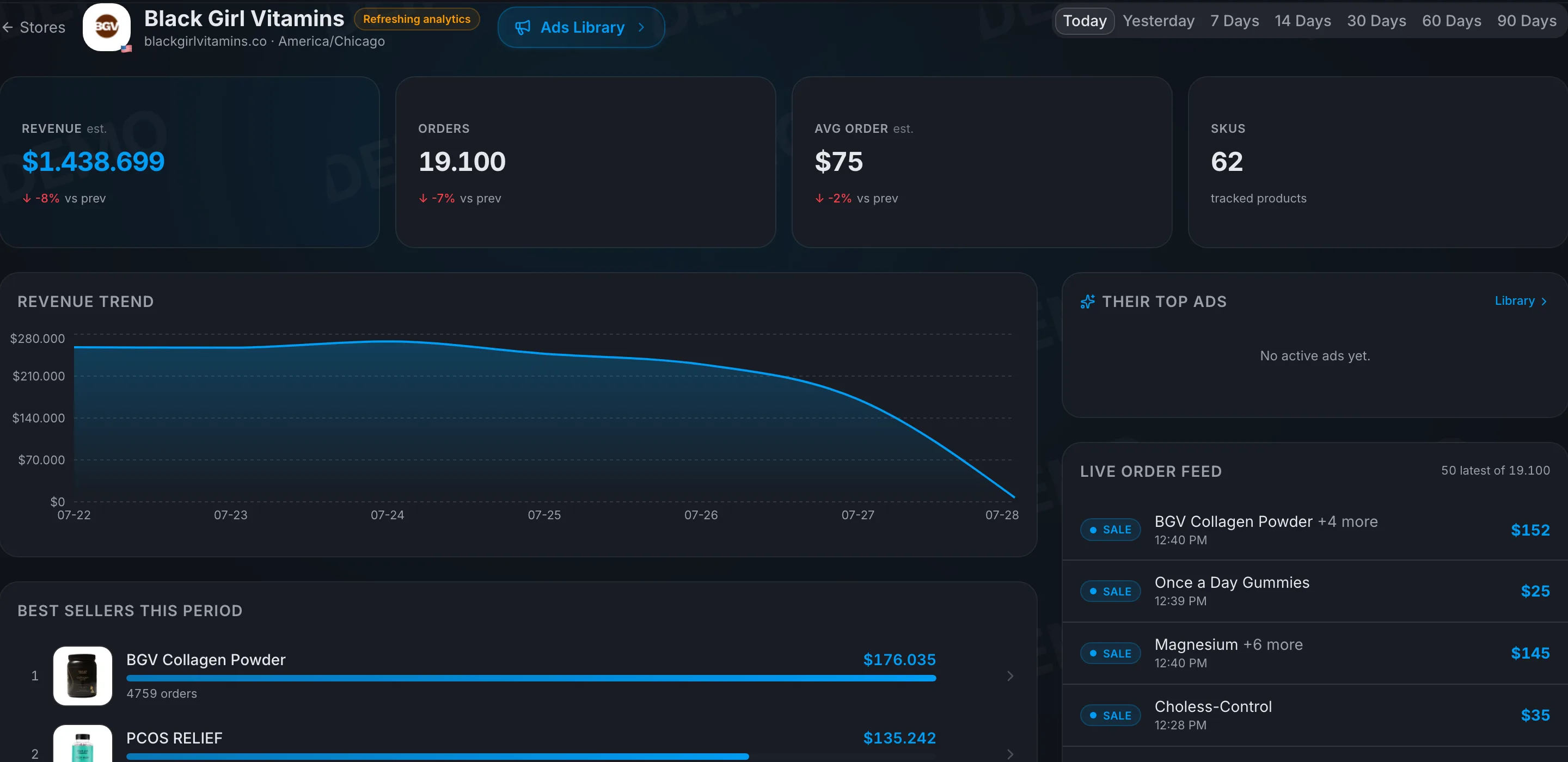
RivlWatch takes a different route: it tracks the Shopify store itself — observed orders, not estimates — and joins that to the Meta ads driving them, with an AI that reads any creative you open. Here is the honest side-by-side, including where AdSpy is the better pick.
| Capability | RivlWatch | AdSpy |
|---|---|---|
| Shopify sales data | Observed live orders | None — ad side only |
| Ads + sales in one view | Yes | Ad → its landing page |
| Meta ad gallery per store | 500, up to 8,000 on demand | Yes — search by advertiser, page or ad text |
| AI reads a creative on demand | Video + audio | Comment search and engagement filters |
| Real audience data (EU reach, age×gender) | Meta DSA disclosures | Assessed targeting (their contributor network) |
| Ad-dependency score (Repeat Index) | Agency plan | Ad-side only — no store sales to score |
| Daily store history | Yes | Ad archive, not store history |
| Credit system | None | None — one flat plan |
| Ask your AI (MCP) | Yes | Not published |
| From | $49/mo | $149/mo flat |
Checked against each vendor’s own site in July 2026 — always confirm current details with them. AdSpy tiers: one flat $149/month plan for what adspy.com calls “virtually unlimited usage” and presents as an introductory offer — no lower tier, no annual option and no free plan listed publicly, with a full refund available within 24 hours of purchase (adspy.com/info).
Where AdSpy shines
- One of the largest searchable Facebook and Instagram ad archives anywhere — adspy.com publishes 207M+ ads from 29M+ advertisers across 225 countries and 88 languages.
- Search depth RivlWatch does not attempt: filter by ad text, advertiser name, number of likes, media type, last seen or longest-running, and search inside an ad’s own comments to read how people reacted.
- Genuinely built for affiliates and media buyers — find ads by affiliate network, affiliate ID or offer ID — on a simple commercial model: one flat price, no credit meter, no tier ladder and no per-search billing, which AdSpy describes as virtually unlimited usage.
Where RivlWatch wins
- AdSpy stops at the ad. RivlWatch keeps going into the store behind it — observed orders, best-sellers and restocks sitting beside that store’s Meta creatives, so you can see which ads run alongside real selling rather than real engagement.
- Engagement is not demand. RivlWatch polls each tracked store’s public storefront around the clock and records an observed order when its product records move together, valuing each item at the product’s lowest listed price. It is a count of orders — not a traffic-based estimate, and not a unit count.
- AdSpy assesses the targeting behind an ad — location, gender and age range, credited on its site to its network of contributors. RivlWatch shows Meta’s own numbers instead: for ads Meta served in the EU, the reach and age×gender split the platform publishes under the DSA.
- RivlWatch’s AI watches a competitor’s video ad end to end — frames and audio — and hands back the spoken hook, the narrative arc and the verbatim CTA; AdSpy gives you the archive and leaves the watching to you. From $49/mo against $149/mo flat, that read comes alongside the Shopify sales layer and an MCP endpoint your own AI assistant can query, neither of which AdSpy publishes.
When AdSpy is the better choice
If your research runs across many advertisers, countries and languages rather than a known set of stores — searching by affiliate offer ID, by comment text, or for the longest-running creative in a vertical — AdSpy’s archive is far deeper than anything RivlWatch offers, and its flat plan is sold as virtually unlimited usage rather than a monthly volume you can exhaust. Buy AdSpy instead. RivlWatch only starts to pay off once you care what the store behind the ad is actually selling.
Coming from AdSpy? Here’s what maps to what
Frequently asked
Is RivlWatch a good AdSpy alternative?
For Shopify sellers, yes. You get the store’s Meta ad gallery plus the thing AdSpy does not sell: the store’s observed orders over time, AI reads of the creatives you open, and Meta’s published EU audience data — from $49/mo. If your job is searching a vast multi-advertiser archive by offer ID, comment text or longest-running ad, AdSpy is still the deeper tool for that one job, and plenty of buyers run both.
How much does AdSpy cost in 2026?
AdSpy publishes a single flat plan at $149/month for what it calls virtually unlimited usage, presented on adspy.com as an introductory offer. No cheaper tier, no annual option and no free plan is listed publicly, and the published policy is a full refund within 24 hours of purchase, with further refunds at AdSpy’s discretion (adspy.com/info). Checked July 2026 — always check adspy.com for current pricing.
Does AdSpy show Shopify sales or store revenue?
No. As marketed on adspy.com, AdSpy is an ad-side tool: it indexes social ad creatives, their engagement, their landing pages and the targeting it assesses for them. It does not track what a Shopify store sells. That is why the two coexist — RivlWatch watches the storefront itself over time, records an observed order when a store’s public product records move together, and joins that daily curve to the same store’s live Meta ads. Revenue is derived from those observed orders, not modelled from traffic.
Does AdSpy have a free trial?
Not one it advertises: neither adspy.com nor its terms page lists a free tier or a free trial, and the published policy is a full refund within 24 hours of purchase, with further refunds at AdSpy’s discretion (adspy.com/info, checked July 2026). RivlWatch’s own trial terms are on the pricing page, and there is a free competitor audit you can run on any brand without an account at all.
AdSpy vs RivlWatch — which is better for finding winning products?
They start at opposite ends. AdSpy finds ads that got attention, and attention is where plenty of winners first surface — its net is far wider than ours. RivlWatch starts from products that are visibly selling: observed orders detected on the storefront day after day, with the Meta creatives running alongside them attached, so a candidate arrives with a sales curve rather than a like count. If you already know whose stores matter, start here; if you are trawling many advertisers, countries and languages, start there.
How much does RivlWatch cost compared to AdSpy?
RivlWatch starts at $49/mo, with $89 and $199 plans above it and a 3-day free trial (card required, nothing charged until it ends). AdSpy starts around $149/mo. There is no credit system: you never top up to run one more search. Each plan has its own limits — stores tracked, ads kept per store, AI analyses per month — and you can see them all on the pricing page.
See the difference on a real store
Open the live demo — real brands, observed sales, real ads — or audit any competitor free in ~30 seconds.