
RivlWatch vs Dropship.io
Dropship.io is a product-research suite for dropshippers: TikTok Shop product, shop and creator libraries with revenue data, a large Facebook ad database that puts a spend figure on every ad, Competitor Research across millions of product listings with one-click Shopify importing, and trackers for TikTok shops, TikTok products and Meta advertisers.
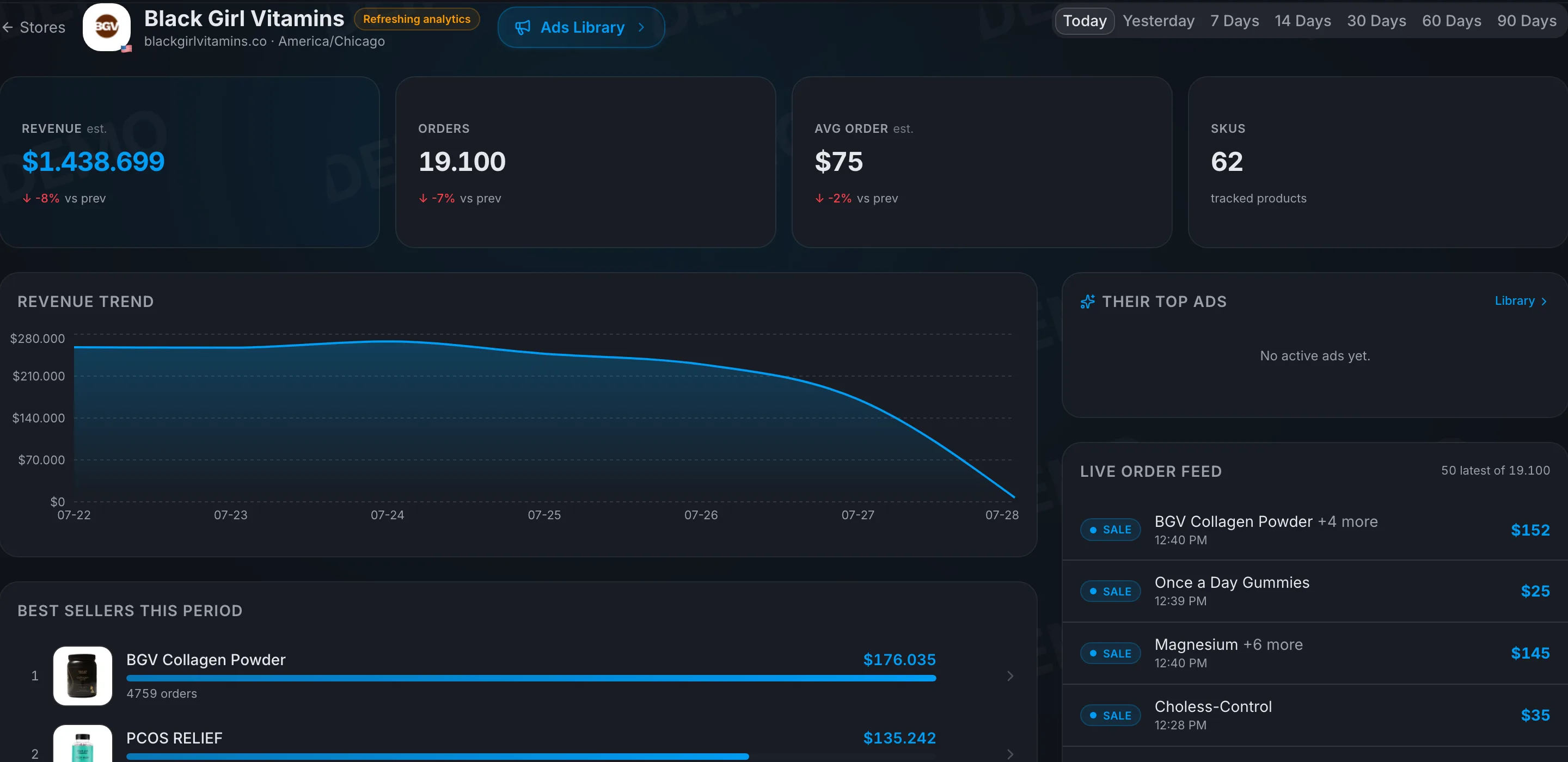
RivlWatch takes a different route: it tracks the Shopify store itself — observed orders, not estimates — and joins that to the Meta ads driving them, with an AI that reads any creative you open. Here is the honest side-by-side, including where Dropship.io is the better pick.
| Capability | RivlWatch | Dropship.io |
|---|---|---|
| Shopify sales data | Observed live orders | Estimated (Sales Tracker is TikTok-Shop-scoped) |
| Ads + sales in one view | Yes | Separate tools |
| Meta ad gallery per store | 500, up to 8,000 on demand | Searchable Ad Library (10k credits/mo on Basic); per-advertiser tracking capped at 10–50 |
| AI reads a creative on demand | Video + audio | Magic AI Search (finds ads) |
| Real audience data (EU reach, age×gender) | Meta DSA disclosures | EU reach + ad-spend figures on ads |
| Ad-dependency score (Repeat Index) | Agency plan | |
| Daily store history | Yes | Daily, on tracked TikTok shops and products |
| Credit system | None | Credits + tracker caps (10–50 TikTok shops) |
| Ask your AI (MCP) | Yes | None published as of July 2026 |
| From | $49/mo | $39/mo ($26 annual) |
Checked against each vendor’s own site in July 2026 — always confirm current details with them. Dropship.io tiers: Basic $39, Standard $59 and Premium $99 a month as of July 2026, or $26 / $34 / $49 a month on annual billing ($312 / $408 / $588 a year), each tier carrying its own per-tool credit balances and tracker caps. Read off dropship.io/pricing; their Shopify App Store listing shows a differently named ladder.
Where Dropship.io shines
- Real breadth. Their Shopify App Store listing claims tracking of “over 3 million Shopify stores”, Competitor Research searches millions of product listings, and the TikTok Shop libraries rank products, shops and over 350,000 creators by revenue. If you want to browse an enormous catalogue and filter for winners, that is genuine coverage a tracked-store model like RivlWatch’s does not try to match.
- One of the few research suites that takes TikTok Shop seriously: shop and product trackers, a Shop Library that ranks TikTok Shops by revenue, sales, growth rate and niche, and a Creator Library for finding the creators promoting a product.
- A complete workflow rather than a single dataset. An Ad Library and Advertiser Tracker that attach a spend figure to every individual ad, Competitor Research that tells you which stores sell a product, the Portfolio feed of hand-picked products delivered weekly, one-click Shopify importing, plus free extras like a theme detector and ROAS, CPA and break-even calculators.
- Generous entry allowances for the money. Basic ships 10,000 Ad Library, 10,000 Advertiser Library and 10,000 Product Library credits a month, which is a lot of browsing before anything runs out, and annual billing brings it to $26/mo.
Where RivlWatch wins
- Dropship.io’s Sales Tracker no longer tracks Shopify. In May 2025 their page read “Sales Tracker enables you to check the sales of any Shopify store or product listing”; today the same sentence reads “any TikTok shop or product listing”, and the page is titled “Watch TikTok Shop sales daily”. If you sell on Shopify, the thing you went there for has moved. RivlWatch still does it: it reads a store’s public storefront every day and records the orders it detects as they happen, then derives revenue from those orders and the listed price.
- Dropship.io’s Sales Tracker is TikTok-Shop-scoped: their own page says it lets you check the sales of any TikTok shop or product listing, and the tracker allowances are counted in TikTok shops and TikTok products. If the competitors you care about are Shopify DTC brands, that is what RivlWatch is built around — per-store daily order history, best-sellers and restock detection on the Shopify stores you pick.
- Dropship.io’s Ad Library is strong, and like RivlWatch it exposes Meta’s DSA-disclosed EU reach — you can filter ads on a minimum and maximum reach. But it is a separate search tool from their sales tracking. RivlWatch puts a store’s sales curve and that same store’s Meta ad gallery in one view, with the DSA age × gender delivery split sitting next to the reach figure (Meta publishes both only for ads that ran in the EU). The point is not the reach number, it is seeing a store’s daily orders beside the creatives running against them.
- Any video creative in the gallery can be read by AI on demand: the model watches the frames and hears the audio, then returns the hook, story arc, CTA wording and a full word-for-word voiceover transcript in the original language. Results are cached, so re-opening a creative you have already read costs nothing. Dropship.io’s Magic AI Search is a matching tool by their own description — upload an image, video or link and it “finds matching products and ads” — so it points you at creatives rather than taking them apart.
- You never pay per look. Dropship.io meters Product Library, Shop Library, Ad Library, Advertiser Library, Creator Library and Magic AI Search in separate credit balances that reset with the billing cycle, so browsing draws a balance down. Competitor Research is the exception — 20 searches a day on Basic, uncapped above it. RivlWatch has no per-view currency at any tier: once a store is tracked, its sales history and its ad gallery stay open to you as often as you like, and re-reading them costs nothing.
When Dropship.io is the better choice
If you want the widest possible net — millions of product listings to search, TikTok Shop and creator data, weekly Portfolio picks and one-click Shopify importing, from $39/mo or $26 on annual billing — Dropship.io is the better buy, and it is the better buy again if the competitors you care about sell on TikTok Shop rather than Shopify. RivlWatch is deliberately narrow: the Shopify stores you have chosen to watch closely, and the Meta ads behind them. If you are still hunting for a product rather than tracking competitors you can already name, start with Dropship.io.
Coming from Dropship.io: what maps to what
Frequently asked
Is RivlWatch a good Dropship.io alternative?
For Shopify competitor research, yes. Both let you watch stores, but RivlWatch observes the orders happening on a store’s public storefront instead of estimating revenue from public signals, and it shows that store’s Meta ads next to the sales curve, with an AI read available on any video creative you open. Dropship.io stays the better pick if your priority is browsing millions of product listings or hunting TikTok Shop winners.
Are Dropship.io’s sales numbers accurate?
Their own documentation calls them estimates, and their Sales Tracker is now pointed at TikTok Shop rather than Shopify, so for a Shopify store the question is moot — the feature moved. We are not going to quote an accuracy percentage at you: the figures circulating online come mostly from other tools’ blogs, and we have no way to audit someone else’s model. What we can tell you is our own method. RivlWatch polls the storefront itself and reports the orders it observed there, each with the time it happened, and derives revenue from those orders at the listed price.
Does Dropship.io track Shopify stores or TikTok Shops?
Both, but the split matters. The store-level tracking is TikTok-Shop-scoped: the Sales Tracker takes a TikTok shop or product listing, the Product Library shows what products a TikTok Shop is selling, the Shop Library ranks TikTok Shops by revenue, and the tracker allowances are counted in TikTok shops and TikTok products. Shopify sits on the ad and competitor side — Competitor Research, one-click Shopify importing, a Chrome extension, and a Facebook Ad Library aimed at surfacing winning dropshipping products, with a Shopify App Store listing that claims tracking of over 3 million Shopify stores. RivlWatch does one narrower thing: it watches the specific Shopify stores you choose, day by day, and the Meta ads behind them.
What does RivlWatch do that Dropship.io doesn’t?
Orders observed off the storefront rather than modelled from public signals. The ads-to-sales join: a store’s daily order curve and that same store’s Meta ad gallery in one view, where Dropship.io keeps sales tracking and its Ad Library in separate tools. AI that watches a video ad’s frames and hears its audio and hands back the hook, story arc, CTA and a full transcript — Magic AI Search, by their own description, matches creatives rather than reading them. And an MCP endpoint, so Claude or ChatGPT can query your stores, sales and creatives directly; Dropship.io publishes no equivalent as of July 2026. RivlWatch also shows Meta’s DSA age × gender delivery split beside EU reach, and on the Agency plan a Repeat Index that scores whether a product keeps selling once its ads stop.
Can I use RivlWatch and Dropship.io together?
Plenty of sellers do, and the split is natural. Use Dropship.io’s libraries and its weekly Portfolio picks to cast a wide net and surface candidates, then move the handful of brands you decide to take seriously into RivlWatch, where each one gets observed daily orders, the store’s Meta ad gallery and AI creative breakdowns.
How much does RivlWatch cost compared to Dropship.io?
RivlWatch starts at $49/mo, with $89 and $199 plans above it and a 3-day free trial (card required, nothing charged until it ends). Dropship.io starts around $39/mo. There is no credit system: you never top up to run one more search. Each plan has its own limits — stores tracked, ads kept per store, AI analyses per month — and you can see them all on the pricing page.
See the difference on a real store
Open the live demo — real brands, observed sales, real ads — or audit any competitor free in ~30 seconds.